
Technology
Troozer.com: What Is It and Can You Trust It?


Troozer.com has attracted attention because different websites describe it in different ways. Some refer to it as a digital publishing platform, while others associate the name with AI tools, online shopping, or business software.
The clearest description comes from Troozer’s own public statement, which identifies it as a digital media and publishing platform. It also says the website is not a marketplace, financial service, or software tool.
That distinction matters when trying to understand what visitors should actually expect from Troozer.com. Here’s what its public information tells us, what remains unclear, and how readers can assess the website.
What Is Troozer.com?
Troozer.com describes itself as a digital media and publishing platform. Its stated purpose is to deliver editorial content across multiple subject areas.
This makes it closer to a general-interest online publication than a dedicated software application or shopping website.
Troozer’s public statement also says that visitors do not need to create an account or provide payment details to access its content. However, these details come from the platform’s own description and should not be confused with an independent assessment of its operations.
For readers, the main distinction is simple: Troozer presents itself as a place to access articles, not as a service offering business software or online transactions.
What Can You Find on Troozer.com?
Troozer’s public statement identifies ten subject areas across its publishing platform:
- Technology
- Finance
- Business
- Health
- Education
- Lifestyle
- Travel
- Law
- Home improvement
- Real estate
This is a broad editorial range, covering everything from digital developments and money-related topics to everyday interests and property.
The presence of these categories helps explain why Troozer describes itself as a multi-topic publication rather than a specialist website.
However, a category list alone does not establish the quality or accuracy of individual articles. Readers should still look at the sources, publication dates, and evidence behind the information they find.
Why Are There Different Descriptions of Troozer.com?
The confusion surrounding Troozer.com largely comes from descriptions published by different websites.
Some third-party articles associate the name with AI tools, cloud storage, productivity software, or online shopping. These descriptions do not match Troozer’s own stated identity as a publishing platform.
There is not enough evidence to establish exactly why these different descriptions appeared. They may reflect repeated third-party claims, outdated information, or confusion about the services associated with the name.
The important point is that a claim repeated across several websites does not automatically become verified.
When researching an unfamiliar platform, its own published information and demonstrable features are more useful than unsupported descriptions elsewhere.
Is Troozer.com Legit?
Troozer.com identifies itself as a digital publishing platform through its public statement. This provides some information about the website’s intended purpose.
However, that description does not independently establish its legal ownership, business registration, or editorial standards.
It would therefore be premature to describe Troozer.com as completely verified or to label it a fraudulent website without stronger evidence.
A sensible assessment separates two questions: whether a website has an identifiable publishing purpose and whether its ownership and published information can be independently trusted.
For Troozer.com, the first has a public explanation. The second still requires further verification.
Is Troozer.com Safe to Use?
Troozer describes its website as an open-access publishing platform and says readers do not need to provide payment details or create an account to access content.
That is useful information about its stated reading experience, but it is not an independent security audit.
As with any unfamiliar website, visitors should check the exact domain before browsing, avoid unexpected downloads, and be cautious about requests for personal or financial information.
An HTTPS connection can protect information exchanged between a browser and a website, but it does not guarantee that every claim or activity on that website is trustworthy.
Readers can also consult the Federal Trade Commission’s online security guidance for practical advice about protecting personal information.
Who Owns Troozer.com?
Knowing who operates a publication can help readers judge its credibility.
Troozer’s public statement explains the platform’s publishing purpose, but it does not establish the legal identity of the person or company operating the domain.
That does not automatically indicate suspicious activity. Some publishers operate under business names, while domain registration details may be protected for privacy reasons.
Still, transparent ownership is particularly valuable when a website publishes information about money, health, business decisions, or legal matters.
Readers interested in researching the domain can use ICANN Lookup to review available registration information.
Registration records may help establish certain domain details, although they do not necessarily reveal the individual or company operating the publication.
Until the ownership can be independently confirmed, it is better not to attribute Troozer.com to a particular person or business.
Can You Trust Articles Published on Troozer.com?
Trust should depend on the quality of the individual article, not simply the website’s appearance.
A useful article should answer the reader’s question clearly, distinguish established facts from opinions, and provide appropriate references where necessary.
For example, a technology article discussing a product’s specifications should ideally link to its official documentation.
A health-related article should rely on qualified medical sources rather than unsupported claims. Financial information should also be checked against authoritative publications or original company disclosures.
Readers should pay attention to the author’s identity, the date of publication, and whether the article explains where its information comes from.
If a particular claim could influence an important decision, confirm it through an independent source.
The same standards apply to Troozer.com. Readers should judge individual articles by their evidence, accuracy, authorship, and usefulness rather than assuming that every published claim is reliable.
Does Troozer.com Offer AI Tools or Online Shopping?
Troozer’s public statement specifically says that the website is not an AI software tool, online marketplace, or financial service.
It also states that the platform does not handle transactions or require credit card details for reading its content.
However, readers should distinguish between what the platform says about itself and what has been independently tested. Its public statement provides a clear description of its intended function, but it is not a technical audit of every possible feature.
For now, the most accurate way to describe Troozer.com is as a multi-category digital publishing platform, rather than a confirmed software or shopping service.
FAQs
What is Troozer.com used for?
Troozer.com is primarily described as a general-interest digital publishing website offering informational articles on subjects such as technology, business, education, finance, and lifestyle.
Is Troozer.com a legitimate website?
Troozer identifies itself as a digital publishing platform. However, its legal ownership and editorial practices have not been independently established, so readers should assess its content carefully.
Is Troozer.com free?
Troozer says readers can access its content without payment details or mandatory account creation. Current access conditions should still be checked directly on the website.
Is Troozer.com an AI platform?
Troozer’s public statement says it is not a software tool. Claims that it offers a dedicated AI platform have not been independently established.
Can I trust Troozer.com reviews and articles?
Some articles may be useful, but readers should check authorship, sources, dates, and important factual claims before relying on the information.
Who is the owner of Troozer.com?
The legal owner or operating company has not been independently confirmed through the public information reviewed. Readers can use ICANN Lookup to examine available domain registration details.
Conclusion
Troozer.com is best understood through its own stated purpose: a multi-category digital publishing platform covering subjects such as technology, finance, business, health, education, and lifestyle.
Its public statement also addresses the confusion surrounding descriptions of AI software, online shopping, and other digital services. Those claims should not be treated as confirmed features without supporting evidence.
Questions about legal ownership and independently verified editorial practices remain open.
For readers, the sensible approach is to treat Troozer.com as a source of general articles, examine the evidence behind individual claims, and verify important information through reliable sources.
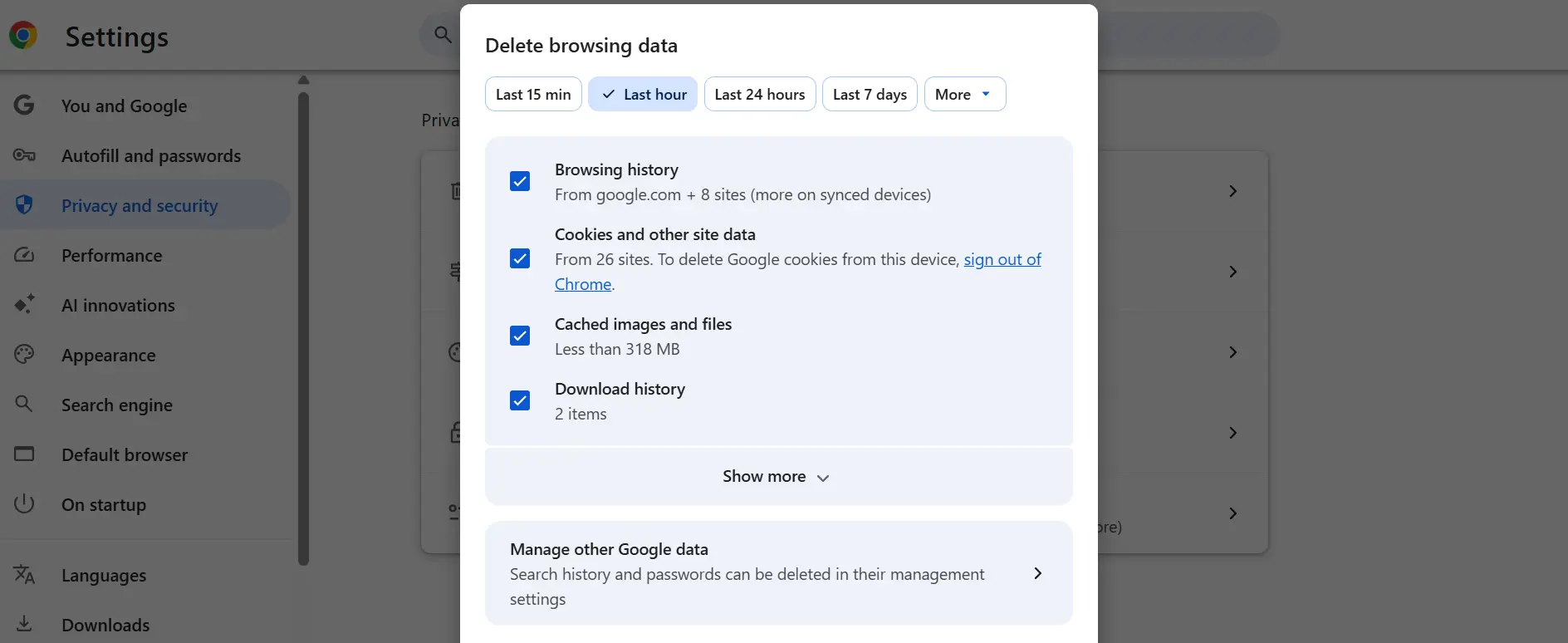
If you need to clear cache for a specific website, you don’t have to delete stored data for every site in your browser. A website may keep showing an old page, refuse to load properly, or get stuck after you sign in.
You can usually remove data for one website through your browser’s settings. Depending on the browser, this may include cached files, cookies, and other saved information. In Chrome, for example, you can find a website under Settings → Privacy and security → Third-party cookies → See all site data and permissions.
The steps differ slightly between browsers. Here’s how to do it.
Learn how to clear cache for a specific website in Chrome, Edge, Firefox, and Safari without deleting data from every site.
How to Clear Cache for One Website in Google Chrome
In Chrome, you can remove the saved data for a particular website without affecting other sites.
-
Open Google Chrome and click the three dots in the upper-right corner.
-
Select Settings.
-
Go to Privacy and security → Third-party cookies.
-
Click See all site data and permissions.
-
Enter the website’s name in the search box.
-
Click the delete icon next to the matching website.
-
Confirm the deletion and reload the page.
For example, if Gmail is having trouble loading, you can look for its stored site data instead of clearing everything from Chrome.
Google explains these steps in its official Chrome cookie management guide.
Keep in mind that deleting site data can sign you out or reset preferences for that website.
How to Clear Cache for One Website in Microsoft Edge
Edge also lets you manage information stored by websites.
-
Open Edge and go to Settings.
-
Open Privacy, search, and services.
-
Find the cookies or site data settings.
-
Open the list of stored website data.
-
Search for the website you want to clear.
-
Delete its stored data and reload the page.
The menu labels may differ depending on your Edge version.
Microsoft’s browser privacy guide explains how Edge handles cookies and browsing data.
How to Clear Cache for One Website in Firefox
If the website is already open in Firefox, you can remove its cookies and site data directly from the address bar.
-
Visit the website in Firefox.
-
Click the padlock or shield icon to the left of the address bar.
-
Select Clear cookies and site data.
-
Confirm the action.
-
Reload the website.
You can also open Settings → Privacy & Security and use the site’s data management options to find and remove stored information.
Mozilla documents both methods in its Firefox support guide.
How to Clear Cache for One Website in Safari
On a Mac, Safari allows you to remove website data individually.
-
Open Safari and select Safari → Settings.
-
Click Privacy.
-
Choose Manage Website Data.
-
Find and select the website.
-
Click Remove, then Done.
This removes data associated with the selected website without requiring you to erase every website’s stored information.
Apple confirms the process in its Safari support documentation.
Can You Refresh a Website Without Clearing Its Data?
Yes. If your only problem is an outdated image or page, try a hard refresh before deleting anything.
On Windows, press Ctrl + Shift + R or Ctrl + F5 while the website is open. On a Mac, Chrome and Firefox support Command + Shift + R.
A hard refresh tells the browser to reload the page’s resources instead of simply reusing its usual cached copies. The exact behavior can vary by browser. It does not necessarily delete all stored files or cookies.
This is worth trying first, especially if you want to stay signed in.
What Happens After You Clear a Website’s Cache?
The website may take a little longer to load the next time you visit because your browser needs to retrieve fresh resources.
If you removed cookies and other stored site data, you may also need to sign in again. Saved website preferences or locally stored information may be reset.
Your bookmarks and data belonging to unrelated websites are generally unaffected when you remove only the selected site’s data.
Removing website data can affect more than cached images and files. Depending on the browser, it may also delete cookies, sign you out, or reset saved preferences. If you only need to load an updated page, a hard refresh is worth trying first.
Conclusion
You don’t need to clear your entire browser cache whenever one website stops working. Start with a hard refresh. If the problem continues, find that website in your browser’s site data settings and remove its stored information.
It’s a targeted way to troubleshoot loading problems while leaving most of your other browsing data alone.

A stock chart can tell you that the market moved. It takes a little more work to understand why it moved-and whether the change matters beyond that trading day.
Fintechzoom.io Nasdaq refers to Nasdaq-related coverage on FintechZoom.io. The website publishes financial content, including an article discussing Nasdaq charts, market news, and analysis. It should not be confused with Nasdaq itself.
For readers, that distinction is a useful starting point. A financial website can explain the market, while Nasdaq operates market infrastructure and provides indexes, data, and financial technology.
This guide looks at what FintechZoom.io offers, what the Nasdaq name means, and where financial innovation is happening behind the headlines.
What Is Fintechzoom.io Nasdaq?
“Fintechzoom.io Nasdaq” combines a website name with a financial-market subject. The reviewed page uses the title “Nasdaq FintechZoom” and describes charts, technical information, and market commentary.
That wording does not, by itself, establish an official partnership or joint product.
The page also makes claims about real-time information and future developments. These should be understood as the website’s claims, rather than independently verified performance findings.
The clearest way to approach the subject is to keep three things separate:
- FintechZoom.io: A website publishing financial content.
- Nasdaq: A company involved in exchanges, indexes, data, and financial technology.
- Nasdaq indexes: Benchmarks that measure the performance of particular groups of securities.
Understanding those differences makes the rest of the coverage easier to follow.
Nasdaq, Nasdaq Composite, and Nasdaq-100 Are Different
Financial headlines often shorten several different subjects to “Nasdaq.” That can make a simple market update confusing.
A story might be discussing the stock exchange, the Nasdaq Composite, or the Nasdaq-100. They are related, but they do not mean the same thing.
The Nasdaq Stock Market
The Nasdaq Stock Market is a securities exchange. Companies listed there have shares that can be bought and sold through the market.
An exchange is different from an index. The exchange supports trading, while an index measures a selected group of securities.
The Nasdaq Composite
The Nasdaq Composite is a broad benchmark covering eligible Nasdaq-listed securities. It includes companies across different industries and sizes.
Nasdaq’s explanation of the Composite and Nasdaq-100 makes clear that the two indexes follow different construction rules.
The Nasdaq-100
The Nasdaq-100 includes 100 of the largest non-financial companies listed on Nasdaq, subject to its methodology. It is not simply another name for the Composite.
That difference matters when comparing a headline with an investment product. Two charts may both carry the Nasdaq name while tracking different groups of companies.
What Can Readers Find on FintechZoom.io?
The reviewed Nasdaq FintechZoom article discusses index performance, charts, technical analysis, and financial news. It presents these as resources for understanding market movements.
Those subjects can introduce readers to market terminology. However, a description of a feature does not confirm its accuracy, update speed, or usefulness for a particular decision.
For example, a page may call a chart “live.” Before relying on it, check the data source, timestamp, and whether the display includes a delay.
Nasdaq’s own Market Activity page notes that public index displays can include delays. Fast-moving graphics alone do not establish that a quote is immediate.
It is also worth separating reporting from prediction. An explanation of yesterday’s movement and a forecast of tomorrow’s price are different kinds of information.
Why Nasdaq Appears in Technology Coverage
Nasdaq-related coverage often connects market performance with developments in software, computing, and other technology businesses.
The Nasdaq-100 also includes companies outside the technology sector, including businesses in areas such as retail and biotechnology. Describing it as a pure technology index would leave out part of its scope.
For a reader interested in innovation, the important connection is between a company’s technology and its business results.
A product announcement may attract attention. The longer-term questions concern customer demand, revenue, costs, and competition.
Imagine a software company introducing an AI feature. The announcement tells you the feature exists. It does not establish whether customers will pay for it or whether it will improve the company’s earnings.
That gap between an interesting idea and a successful business is where much financial analysis begins.
Financial Innovation Goes Beyond Trading Apps
A new app is easy to notice. The technology supporting financial markets is often less visible.
Nasdaq’s cloud technology overview describes products involving market data, risk management, surveillance, and cloud-based services.
These systems serve different jobs. A data service helps users access information. A risk tool helps an institution assess exposures. Surveillance software supports the monitoring of trading activity.
For someone reading about fintech, that is a broader picture than mobile payments or online investing alone.
The future of financial technology also concerns how institutions organize information, monitor activity, and keep services operating reliably.
AI Is Being Used to Address Financial Crime
Fraud detection is one documented area where Nasdaq applies AI-related technology.
Its Financial Crime Management Technology page describes Nasdaq Verafin’s work in fraud prevention, anti-money laundering, and financial-crime management. The company presents machine learning and AI as parts of those services.
This is separate from FintechZoom.io’s editorial coverage. A website discussing financial innovation should not be credited with developing another company’s systems.
The practical purpose is easier to understand through an example. A financial institution may need to examine unusual transactions and decide which cases require closer investigation.
Software can help organize that work and identify patterns. An alert, however, is not the same as a final finding about what happened.
When reading product claims, look for the task being supported, how results are evaluated, and what responsibility remains with the institution.
Cloud Services Are Part of Market Modernization
Cloud technology also appears in Nasdaq’s plans for modernizing markets.
The company describes a cloud-enabled approach alongside products for data access, risk management, and trade surveillance. These are documented areas of its financial-technology business.
For readers outside the industry, the key point is that financial innovation often happens within systems they never directly use.
A customer may see an account screen or a market quote. Behind that screen are services responsible for processing information and supporting operations.
A useful article should explain what a new system changes. “Moving to the cloud” is a description of an approach, not enough evidence on its own to establish better results.
How to Read Market Charts With More Context
A chart needs context before it can answer a useful question.
Start with the label. Is it showing an individual stock, the Nasdaq Composite, or the Nasdaq-100?
Then check the time period. A sharp movement on a one-day chart may look very different across several years.
The scale matters too. A cropped price axis can make a modest change appear dramatic.
Next, separate the movement from the explanation. A headline may connect a market rise with one announcement, even though several developments occurred during the same session.
Charts help show what happened. Explaining the cause usually requires additional evidence.
What the Future Could Bring
Financial technology is likely to keep changing how information is collected, analyzed, and used. But the phrase “future of financial innovation” should not become a promise of easy profits.
The documented examples here concern market infrastructure, data services, cloud systems, and financial-crime technology. They show areas where Nasdaq offers products and describes ongoing work.
They do not establish a future stock price or guarantee that a particular company will benefit.
For readers following Fintechzoom.io Nasdaq, the most useful coverage will connect an announcement with a clear business purpose. Who uses the technology? What problem does it address? What evidence supports the claimed improvement?
Those questions make a story easier to assess without requiring readers to become market professionals.
Conclusion
FintechZoom.io’s Nasdaq content can introduce market subjects, but the website and Nasdaq serve different roles. Keeping that distinction clear prevents commentary, index information, and financial products from being mixed together.
The more interesting innovation story lies in the details: better access to data, tools for investigating financial crime, and systems supporting market operations.
Good coverage explains those changes plainly. It leaves readers understanding more than the direction of a line on a chart.

There is plenty of news about artificial intelligence. What is often missing is a clear explanation of what a new tool can actually do.
Drovenio Latest Technology News is a heading used on Drovenio.blog for coverage of AI, software, cybersecurity, and digital innovation. The website presents itself as a place to read about technology developments and their everyday uses.
This Yippo Labs overview explains what the Drovenio name refers to, what the reviewed websites cover, and how those subjects connect to documented AI developments.
The distinction matters. A website reporting on AI is different from the company building the tools.
What Is Drovenio?
Drovenio.blog publishes technology content. Its homepage lists artificial intelligence, digital transformation, cybersecurity, software, and emerging technology among its subjects.
A similarly named website, Droven.io, presents itself as an editorial resource. Its sections include generative AI, business applications, software development, cloud computing, and tool reviews.
The reviewed homepages do not establish that the two websites share ownership. Their similar names should not be taken as proof that they are the same publication.
They also do not establish Drovenio as the developer of the AI systems discussed here. Those systems need to be traced to their respective companies and original announcements.
What Does Drovenio’s Technology Coverage Include?
The reviewed pages cover several connected areas of technology. Some introduce software tools, while others discuss how businesses use AI and automation.
For readers, the value depends on how clearly an individual article explains its subject. A useful overview should leave you knowing what something does, where it might help, and what remains uncertain.
Artificial Intelligence and AI Tools
AI is a central subject across both reviewed websites. Their listed sections include generative AI, tools, applications, and business uses.
These subjects can help readers understand unfamiliar products. However, an article describing a tool is not evidence that its writer has tested it.
That difference matters in a review. An explanation based on documentation should be presented differently from findings based on direct use.
Software and Digital Work
Droven.io lists software development, web development, and productivity tools among its subjects. Drovenio.blog also includes software and applications in its stated coverage.
These are practical topics because software choices affect ordinary work. A team may need help comparing applications, understanding a feature, or deciding whether an upgrade solves an existing problem.
The best explanation starts with that problem. A long feature list means little until someone explains which features matter for a particular task.
Cybersecurity and Privacy
Cybersecurity appears on both reviewed sites, with Droven.io also naming data privacy in its navigation.
Security coverage needs clear sourcing. Advice about account protection or handling business information should be grounded in current documentation rather than broad claims about being safe.
AI Is Moving Beyond the Chat Window
One important direction in AI is the move from generating responses to taking actions inside software.
An assistant that explains how to prepare a report offers one kind of help. An assistant that opens the relevant files and works through the task offers another.
Google described this direction in its June 24, 2026, announcement about computer use in Gemini 3.5 Flash. The company said developers could build agents that interact across browser, mobile, and desktop environments.
Its stated uses included software testing and work across professional applications. These are Google’s descriptions of the capability, rather than independent test results produced for this article.
The appeal is easy to understand. Many assignments involve finding information, comparing it, and moving it between tools before the final writing begins.
But that also creates more opportunities for error. Selecting the wrong document at the start can affect everything that follows.
Why Small Details Still Matter
Consider a request to compare this month’s sales with last month’s. The calculation may be simple, but the meaning of “sales” needs to be clear.
It could refer to orders placed, payments received, or completed deliveries. Canceled orders might also need separate treatment.
A person familiar with the business may already know which figures to use. An assistant needs that information in the instructions or supporting records.
If it is missing, asking a short question is better than quietly making the wrong choice.
What AI Agents Could Change at Work
An AI agent generally works toward a goal through several steps. Depending on its design, it may use tools, inspect results, and choose the next action.
Consider a hypothetical customer-service task. Before preparing a useful reply about a late delivery, an assistant would need the correct order record and shipping information.
Writing the message is only one step. The harder part is making sure the answer matches the customer’s situation.
Anthropic’s February 17, 2026, Sonnet 4.6 announcement described improvements in coding, computer use, reasoning, and agent planning. It also acknowledged that computer-use performance still had limits.
A documented improvement can be meaningful without making a system dependable for every assignment.
For a small business, a reasonable trial might involve one repeatable internal task. The team can compare the output with the original records and measure the effort needed to finish it.
Working With Images, Charts, and Documents
Another area worth understanding is multimodal AI: systems designed to work with different forms of information, such as text and images.
The benefit becomes clearer with an ordinary example. A chart contains more than its title. Its labels, scale, units, and time period all contribute to its meaning.
An assistant might identify a rising line correctly while missing that the chart covers only two weeks. Its explanation could sound sensible but leave out the detail that matters most.
Screenshots present a similar challenge. They can show an error message without showing the actions that caused it.
A helpful explanation separates what is visible from what is being inferred. That makes the answer easier to follow and check.
What These Tools Could Mean for Small Businesses
Small businesses do not need to follow every AI announcement. They need to know whether a tool helps with work they already do.
Possible trial tasks include organizing approved documents, preparing draft summaries, or turning meeting notes into a proposed action list. These are examples to test, not promises that every tool will handle them well.
Take a team that prepares the same internal report each week. It could compare its usual process with an assisted version using the same records.
The team would then check the figures, review the wording, and count the corrections required.
That produces a more useful answer than a broad promise of improved productivity. It shows whether the tool helps with a specific job.
Accuracy and Security Belong in the Same Conversation
The more an assistant can do, the more its mistakes can affect the task.
NIST’s Generative Artificial Intelligence Profile, published in July 2024, identifies confabulation as a risk. This includes generated information that is false or mistaken but presented convincingly.
Computer use introduces another concern. Anthropic’s Sonnet 4.6 announcement discusses prompt injection, where instructions in material an assistant encounters attempt to redirect its behavior.
These issues help explain why the task matters as much as the model. Preparing a draft leaves room for review. Sending a message or changing a live record gives an error a different consequence.
A useful workflow makes those boundaries clear. People should know what the assistant can change and which decisions require their approval.
How Useful Is Drovenio Latest Technology News?
Drovenio-related pages can serve as an introduction to technology subjects. The reviewed homepages show an editorial focus on AI, software, business technology, and related areas.
That does not establish the accuracy of every article. Each claim still needs to stand on its own evidence.
When an article discusses a product, the most helpful questions are straightforward:
- Who developed it?
- When was the feature announced?
- Is it publicly available or limited to a preview?
- Does the article describe direct testing or company claims?
- What limitations are documented?
An older announcement can still provide useful background. It simply needs to be identified as background rather than presented as breaking news.
The same applies to predictions. A company’s plans can explain its direction, but they do not establish when a future feature will become available or dependable.
What to Watch Next in AI
Some valuable improvements may be easy to overlook.
An assistant that recognizes missing information could prevent an incorrect report. One that keeps track of an unfinished assignment could save someone from explaining the task again.
Better handling of interruptions would help too. Real work rarely follows a perfect sequence from beginning to end.
These offer practical ways to judge progress. Can the tool finish the assignment? Can someone check what it did? Does it know when to ask for help?
Future announcements will offer plenty of ambitious answers. Everyday use will show which improvements hold up.
Conclusion
Drovenio’s reviewed pages place it within technology publishing, with subjects ranging from AI tools to software and cybersecurity. Understanding that role makes its coverage easier to interpret.
The next step is to follow important claims back to their original sources. That is where readers can establish what was announced, who can use it, and what the developer actually promises.
For next-generation AI, those details tell a more useful story than predictions alone.
-

 News5 days ago
Fintechzoom.io Nasdaq: The Future Of Financial Innovations
-

 Technology5 days ago
Drovenio Latest Technology News: The Future Of Next-Gen AI Innovations
-

 Home & Living5 days ago
Homecz: The Ultimate Guide to Modern Smart Home Living
-

 Entertainment5 hours ago
How to Play Google Doodle Baseball Right Now
-

 Games5 hours ago
Freeze Nova Cloud Stream Free Games
-

 Health & Wellness1 hour ago
Lyposingrass: What Is It and Is It a Real Plant?
-
 Technology31 minutes ago
How to Clear Cache for a Specific Website