
Technology
Zecway: Features, AI Tools, and Company Overview

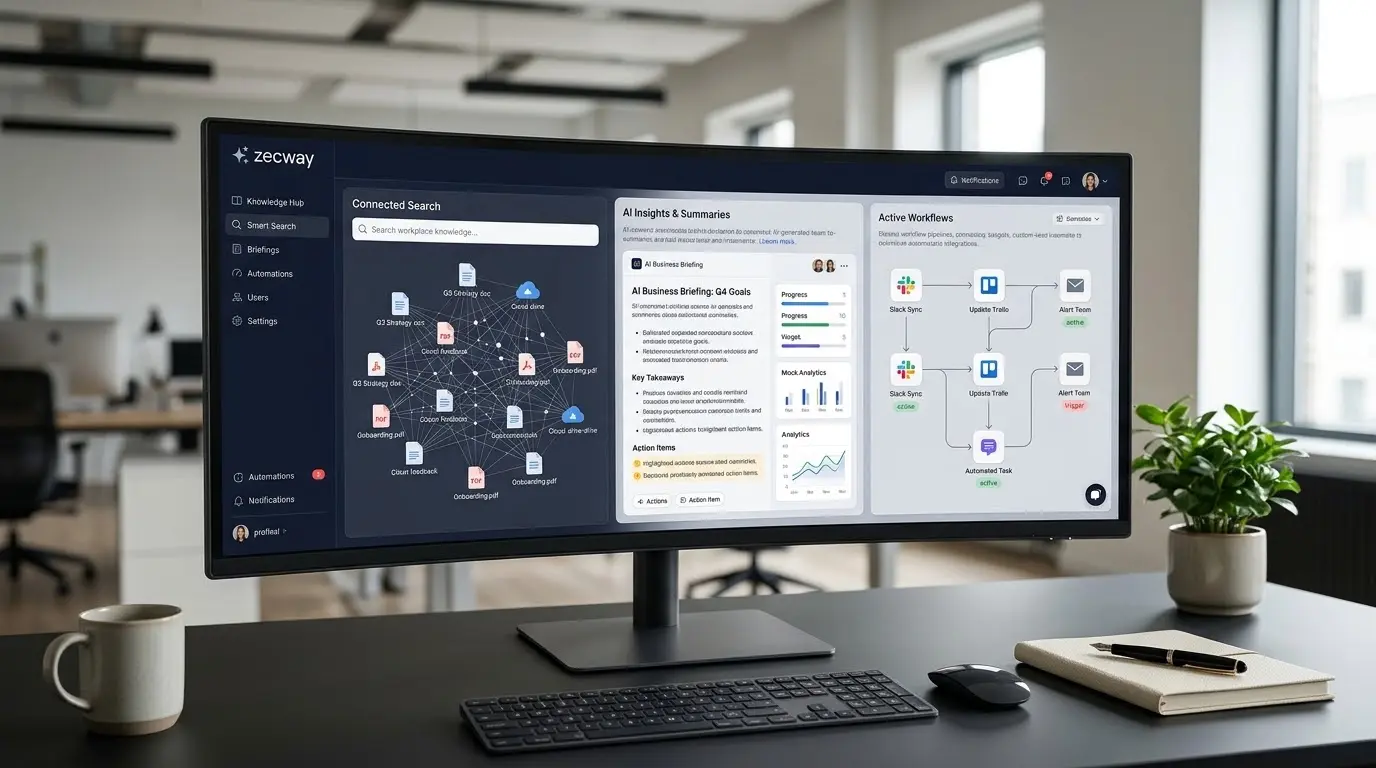
Finding information inside a growing company can become surprisingly difficult. Important documents may be stored in Google Drive, project discussions happen in Slack, and decisions are recorded in email conversations. Employees often spend valuable time searching across these platforms instead of completing their actual work.
Zecway is an emerging AI-powered workplace search and knowledge management platform designed to bring company information into one searchable environment. Its broader product vision combines workplace search with an AI assistant that is rolling out and AI agents intended to handle recurring tasks.
The platform is particularly interesting because it focuses on information companies already possess rather than simply generating answers from general internet knowledge.
However, Zecway is still promoting limited early access, and several details about its integrations, pricing, and enterprise readiness require further confirmation.
What Is Zecway?
Zecway is a workplace technology platform that aims to make internal company knowledge easier to find and use.
Its official website describes the product as a company-wide intelligence layer that connects information scattered across workplace applications.
Instead of opening several applications to locate a document or understand a previous decision, employees can ask questions through a centralized search experience.
For example, an employee might ask:
Where is the latest pricing presentation, and what changes were discussed in the team conversation?
Rather than returning only a document name, Zecway demonstrates an answer that connects a Google Drive presentation with the relevant Slack discussion.
This approach is intended to help employees find both the information and the context surrounding it.
Zecway positions itself around three main capabilities:
-
Unified workplace search.
-
An AI assistant grounded in company information.
-
AI agents designed to perform recurring research and workflow tasks.
These capabilities are presented as connected parts of one workplace knowledge system.
Zecway Company Overview and Business Details
Zecway has an online company profile identifying its business as software development, with its headquarters in Bangalore, Karnataka, India.
Its LinkedIn company profile describes it as a privately held business founded in 2026, with a listed company size of 2–10 employees. These are company-profile details rather than independently audited workforce figures.
| Company Detail | Information |
|---|---|
| Company Name | Zecway |
| Industry | Software Development |
| Business Focus | Workplace AI and Knowledge Management |
| Headquarters | Bangalore, Karnataka, India |
| Business Type | Privately Held |
| Founded | 2026, according to its LinkedIn profile |
| Listed Company Size | 2–10 employees |
| Official Website | zecway.com |
| Main Product Areas | AI Search, AI Assistant, AI Agents |
Zecway and Zecway Studio LLP: Understanding the Difference
There is another business-history detail worth understanding.
Indian business-directory records identify Zecway Studio LLP, a limited liability partnership incorporated on June 30, 2024, under LLPIN ACI-1103 in Bangalore.
Older online descriptions associate Zecway Studio with creative and marketing services, including branding and digital marketing.
The current Zecway website, however, presents an AI workplace search product.
Although the names are similar, the available public information does not conclusively establish whether Zecway Studio LLP owns, operates, or is legally connected to the current AI workplace product.
They should not automatically be treated as the same operating business.
This distinction helps readers avoid confusing a registered creative-services business with the newer AI software offering.
What Are the Main Features of Zecway?
Zecway’s product is organized around three layers. Each addresses a different part of everyday workplace information management.
1. Unified AI Workplace Search
The first feature is a centralized search experience for company information.
Employees can use natural-language questions rather than remembering exact document names, folder locations, or conversation keywords.
For example, someone preparing a client presentation might search for the latest pricing policy.
The platform’s demonstration shows results connecting a Google Drive file with a related Slack conversation.
This is useful because finding a document does not always explain why it was updated or which decision influenced its contents.
Zecway aims to bring those connected pieces of information together.
Its public website specifically demonstrates Google Drive and Slack. A complete, independently confirmed integration directory is not publicly established, so businesses should check support for their other applications before adopting the platform.
2. AI Assistant for Business Tasks
The second layer is an AI assistant intended to use internal company knowledge when generating responses. According to Zecway, this capability is rolling out as part of its broader workplace platform.
Instead of relying entirely on general AI knowledge, the assistant is presented as using connected business documents and conversations to prepare drafts, summaries, and other work materials.
Consider a company responding to a client’s request for proposal (RFP).
The team may need information from previous proposals, internal security policies, and compliance documents.
An AI assistant could use those materials to prepare an initial response with references to the underlying sources.
Zecway demonstrates this approach through an example involving a security questionnaire and internal company documentation.
The generated content can then be reviewed and edited before being sent to the client.
An important limitation remains: source citations help employees check information, but they do not automatically guarantee that the original document is accurate or current.
3. AI Agents and Workflow Automation
The third layer is Zecway’s planned AI-agent capability, designed to handle recurring research and prepare actions for employee approval.
Zecway describes these agents as digital teammates that can be assigned tasks using ordinary language.
For example, a company could want a weekly summary of changes in important project documents.
A proposed workflow might involve:
-
Starting automatically at a scheduled time.
-
Researching relevant company information.
-
Preparing a summary of important changes.
-
Sending the prepared result to a workplace channel after human approval.
The human approval stage is particularly important.
It allows employees to review an agent’s work before an external or internal action is completed.
Zecway’s website demonstrates this as part of its intended agent experience, but the availability of these capabilities should be confirmed during early-access onboarding.
How Does Zecway Work?
Zecway is designed to connect company applications and make their information accessible through a centralized interface.
Its intended workflow can be understood in four stages.
Connecting Workplace Applications
The first step is connecting the applications where company information is stored.
These may include document repositories and team communication tools. Google Drive and Slack are specifically demonstrated in Zecway’s public materials.
The purpose is to reduce the need to search through separate applications manually.
Searching Company Information
After connecting supported sources, employees can ask questions in everyday language.
For example:
-
Find the latest company pricing document.
-
Locate the discussion about a delayed project.
-
Find the policy governing customer refunds.
-
Summarize recent changes to a project document.
The system is designed to return relevant information with links to its original sources.
Generating AI Responses
AI agents add another layer by preparing recurring research and workflow tasks.
Employees can inspect the references and edit the generated content before using it.
Automating Repetitive Activities
AI agents add another layer by preparing recurring research and workflow tasks.
Instead of manually requesting the same weekly update, a team could configure a scheduled process to prepare it automatically.
The proposed workflow still includes human approval before actions are sent.
How Does Zecway Approach Data Privacy and Security?
Security is particularly important for workplace AI because connected applications may contain confidential business information.
Zecway publicly emphasizes permission-aware search.
According to its website, access permissions are enforced before information reaches the AI system. This means employees should only receive information they are already authorized to access.
For example, an employee without finance permissions should not receive restricted financial documents simply because they ask an AI assistant a relevant question.
The company also emphasizes source citations, allowing users to inspect where answers originate.
However, there is an important distinction between advertised security architecture and independently verified security performance.
Before connecting sensitive company information, businesses should request details about:
-
Data storage locations.
-
Encryption practices.
-
Data retention and deletion.
-
Security certifications and independent audits.
-
Access logs and permission changes.
-
Data processing agreements.
-
How information is handled by underlying AI providers.
The availability of detailed public security documentation remains limited.
Who Can Benefit From Zecway?
Zecway is positioned for businesses that manage information across multiple workplace applications.
Its LinkedIn profile identifies teams of approximately 30–500 employees as its intended audience. This is its stated target market, not a strict eligibility requirement.
Some potential use cases include:
Growing businesses: Employees can locate company policies, documents, and previous decisions without repeatedly asking colleagues.
Sales teams: Representatives can find pricing information, previous proposals, and customer discussions when preparing new opportunities.
Human resources: Teams could use internal documentation to locate company policies and prepare routine employee communications, subject to access permissions.
Project managers: Project-related information could be brought together to prepare progress summaries and identify recent changes.
Management teams: Decision-makers could use company-wide information to prepare internal reports and review previous discussions.
These are potential applications of the advertised product capabilities, not independently verified customer outcomes.
Is Zecway Free? Pricing and Availability
Zecway currently promotes a limited early-access registration option through its official website.
The registration page requests a work email address and states that a credit card is not required to request access.
However, a complete public pricing structure has not been established.
The website does not provide enough information to confirm standard subscription prices, enterprise packages, storage limits, or long-term free-plan availability.
Businesses considering the platform should contact Zecway directly to clarify:
-
Early-access eligibility.
-
Available integrations.
-
Subscription arrangements.
-
User limits.
-
Implementation requirements.
-
Support and onboarding.
-
Data security documentation.
It is better to confirm these details before connecting important company systems.
What Are the Limitations of Zecway?
Although its concept addresses a genuine workplace problem, several considerations deserve attention.
Early-stage availability: Limited early access means that businesses should not assume every advertised capability is ready for general commercial deployment.
Integration coverage: The website demonstrates Google Drive and Slack, but a complete integration directory is not publicly available.
AI accuracy: Even when answers include citations, employees must verify important information before using it in business decisions.
Security verification: Permission-aware search is a useful design principle, but independent security assessments and detailed certifications need confirmation.
Pricing transparency: Without a published pricing structure, businesses cannot easily calculate the total cost of adoption.
These limitations do not establish that Zecway is unreliable. They identify the questions potential users should investigate.
Conclusion
Zecway represents an emerging approach to workplace productivity by bringing company search, AI assistance, and workflow automation into one environment.
Its central idea is to help employees spend less time locating information and more time using it.
The combination of source-linked answers and permission-aware search is particularly relevant to organizations managing large amounts of internal information.
However, the platform is still in limited early access, and its pricing, full integration coverage, and independently verified security arrangements need further confirmation.
For businesses interested in workplace AI, Zecway is a platform worth examining through a controlled trial before making a wider adoption decision.
Frequently Asked Questions
What is Zecway used for?
Zecway is designed to help businesses search internal information, generate AI-assisted documents and summaries, and prepare recurring tasks through AI agents.
Is Zecway an AI platform?
Yes. Its current product positioning focuses on workplace AI, enterprise search, knowledge management, and workflow agents.
Which applications does Zecway support?
Its public website demonstrates Google Drive and Slack. Additional integrations should be confirmed with the company.
Is Zecway free?
The company offers a limited early-access registration option without requiring a credit card. Its permanent pricing and free-plan arrangements have not been publicly established.
Who owns Zecway?
The exact legal ownership of the current AI product is not clearly established through the reviewed public information. Zecway’s LinkedIn page identifies it as a privately held business.
Is Zecway available for small businesses?
Its stated target audience includes teams of approximately 30–500 employees. Smaller businesses can enquire about early access and suitability.
Does Zecway replace Google Drive or Slack?
No. Its intended role is to connect information from existing workplace applications rather than replace those applications.
Is Zecway safe for confidential company information?
Zecway advertises permission-aware information retrieval. However, businesses should review its security documentation, privacy terms, and data-handling arrangements before connecting confidential information.

Unfamiliar words regularly appear in online conversations, social media captions, gaming communities, and digital publications. Some become popular expressions, while others develop meanings within smaller groups. Frehf is one of those unusual terms that has attracted attention because different websites use it in different ways.
Online articles attach several interpretations to Frehf. Some present it as a creative or informal expression, while others describe a four-pillar framework for planning and organizational improvement. However, these explanations do not establish a single accepted meaning or prove that the term is widely used in everyday conversations.
Frehf is an emerging online term without a universally accepted dictionary definition. Its meaning depends on the context in which it appears, and some of the explanations attached to it remain unverified.
What Does Frehf Mean?
Frehf does not have one widely recognized definition in standard English.
Instead, its online interpretations generally fall into three categories:
| Interpretation | How it is described |
|---|---|
| Internet expression | Described by some websites as an informal expression, although widespread use has not been established. |
| Creative identity | A stylized expression associated with originality or freshness |
| Management framework | A four-part approach to planning, decision-making, and improvement |
These interpretations appear in online publications, but that does not mean they represent one connected movement or officially established concept.
The most useful way to understand the word is to consider where it appears.
Someone using Frehf in an informal online conversation may intend something completely different from a business writer discussing organizational improvement.
How Is Frehf Used Online?
The internet allows people to create expressions that do not necessarily follow conventional spelling or dictionary definitions.
Frehf is described in several online articles as a flexible expression that can communicate different ideas depending on the situation.
In Social Media Conversations
Some publishers describe Frehf as an informal reaction used in chats, comments, and online discussions.
For example, someone might use it as a playful response to an unexpected situation or an unusual video.
However, there is insufficient independent evidence to establish it as widely recognized social media slang.
Its meaning should therefore be interpreted through the surrounding conversation rather than assumed.
In Creative Projects and Branding
Another interpretation connects Frehf with originality, experimentation, and a fresh approach to creative work.
Under this interpretation, it functions more like a brand-style expression than a conventional word.
A designer might use an unusual name to make a project memorable or distinguish it from similar products.
However, the connection between Frehf and the English word fresh is an interpretation, not a documented linguistic origin.
What Does FREHF Stand For?
Some online publications expand FREHF as “Future Ready Enhanced Human Framework.” However, this appears to be a repeated online interpretation rather than a verified official expansion.
Neither its original creator nor its official status has been independently established.
Historical indexed material associated with Frehf.org presents a different emphasis: a structured framework built around four principles. It does not provide equally clear evidence that the longer expansion was the original name.
This distinction is important because repeating an acronym across several websites does not establish its authenticity.
Understanding the Four Pillars of Frehf
Historical indexed content associated with Frehf.org described four principles: Strategic Alignment, Data Awareness, Behavioral Insight, and Iterative Improvement. This shows how the former website presented the framework, but it does not establish independent validation or formal recognition.
These principles provide the clearest identifiable framework associated with the term.
1. Strategic Alignment
Strategic alignment means ensuring that everyday activities support larger objectives.
For a business, this could involve connecting departmental responsibilities with company goals.
For example, if a company wants to improve customer retention, its marketing, customer support, and product teams should work toward that shared objective.
2. Data Awareness
Data awareness involves using relevant information to support decisions.
Rather than relying entirely on assumptions, individuals and organizations examine useful measurements, customer feedback, and performance indicators.
A business might review customer complaints to identify recurring service problems before changing its operations.
The objective is not to collect as much data as possible. It is to understand which information actually matters.
3. Behavioral Insight
Behavioral insight focuses on how people think, make decisions, and respond to different situations.
A company introducing new software, for example, needs to understand whether employees can use it comfortably.
Training, motivation, communication, and workplace habits can all influence whether a new process succeeds.
4. Iterative Improvement
Iterative improvement means making adjustments, examining the results, and improving the process over time.
Instead of attempting to change everything at once, a team might introduce one improvement, measure its effect, and decide what should happen next.
This resembles established continuous-improvement practices such as the Plan-Do-Check-Act cycle.
These four ideas are established management concepts. Their appearance together under the name does not establish that the framework itself is an academically validated methodology.
Is Frehf a Real Word, Website, or Digital Platform?
These are three different questions.
As a word: Frehf appears in online publications, but it is not established as a standard English dictionary term with one accepted definition.
As a framework: Historical indexed material associated with Frehf.org describes a four-pillar approach to planning and improvement.
As software: There is insufficient evidence to establish a functioning commercial application, verified login service, or official subscription product.
Some articles use technology-related language when describing Frehf, including references to automation and artificial intelligence. Those descriptions should not be interpreted as proof that an actual software platform exists.
Why Do People Search for Frehf?
Unusual words naturally generate curiosity.
When people encounter an unfamiliar expression, they often search for its definition, background, and possible applications.
Frehf also has several characteristics that can encourage searches:
-
Its unusual spelling makes people question its meaning.
-
Different websites provide competing explanations.
-
Some publishers associate it with modern digital culture.
-
Its acronym interpretation creates interest in business and technology.
-
The four-pillar framework provides a practical subject for further discussion.
However, the number of websites publishing an explanation does not establish widespread adoption.
A keyword can attract search interest without representing a recognized social movement, technology product, or professional methodology.
Conclusion
Frehf demonstrates how an unfamiliar expression can develop several interpretations across online publications and digital communities.
Some explanations connect it with playful internet language and creative identity, while others associate it with organizational planning and continuous improvement.
The four principles linked to its earlier framework offer recognizable management ideas, but the term itself does not have an established dictionary definition or independently verified official expansion.
For readers encountering Frehf online, context is the most useful guide. Understanding where and how someone uses the word is more reliable than assuming every published explanation describes the same concept.
Frequently Asked Questions
What does Frehf mean?
Frehf is an online term with no universally accepted definition. Different websites associate it with informal expression, creative identity, and a four-pillar management framework.
What does FREHF stand for?
One commonly reported expansion is Future Ready Enhanced Human Framework. However, its official origin has not been independently confirmed.
Is Frehf an English word?
It appears in online publications, but it is not established as a standard English dictionary word.
Is Frehf a slang word?
Some websites describe it as informal internet slang. Its widespread recognition and consistent meaning have not been established.
What are the four pillars of Frehf?
They are Strategic Alignment, Data Awareness, Behavioral Insight, and Iterative Improvement.
Is Frehf an AI platform?
There is insufficient verified information to identify as a functioning AI platform or commercial software product.

EO PIS appears in online articles about business operations, performance measurement, and management dashboards. The explanations generally describe a way of bringing operational information and performance measurements together so managers can review business results.
However, the term has one notable complication: different online sources give it different full forms.
EO PIS does not have a single authoritative full form established by the sources reviewed for this article. Its online descriptions overlap with familiar business reporting practices, but they do not establish one official software product or standardized management framework.
Understanding the phrase therefore means separating its reported meanings from the documented technology behind business performance reporting.
What Is EO PIS?
In business-focused articles, EO PIS is used as a label for organizing operational information and reviewing performance.
For example, a company might keep sales figures in one application, delivery records in another, and operating expenses in accounting software. A reporting system could bring selected measurements from those sources into a shared view.
That describes a practical business function. It does not, by itself, establish EO PIS as the formal name for that function.
The reviewed articles use the phrase inconsistently. Without an originating organization, published specification, or identifiable product documentation, readers should treat its meaning as dependent on the source using it.
What Is the Full Form of EO PIS?
EO PIS does not have one consistently established full form in the sources reviewed. Online explanations associate it with business operations, performance measurement, and the management of company information.
Two reported expansions are Enterprise Operations Process Information System and Executive Operations Performance Indicator System. Both appear in online business explanations, but the available evidence does not establish either as an officially recognized industry definition.
These variations make it difficult to identify a single accepted definition. Without an originating organization, official specification, or identifiable product documentation, neither expansion should be treated as an established industry standard.
If you encounter EO PIS in a workplace document or business proposal, check how the organization using it defines the abbreviation. Its intended meaning may depend on that specific context.
How Would the Reporting Approach Work?
Because no common EO PIS specification was established, there is no verified universal workflow to describe.
The following example explains ordinary performance reporting—the business activity associated with the phrase—rather than confirmed features of an EO PIS product.
Choose a Business Question
A useful report starts with a question.
An online retailer might ask why customer complaints increased despite stronger sales. That question helps determine which information deserves attention.
Collecting every available number would make the report harder to interpret.
Gather Relevant Records
For this example, the retailer could examine order totals, dispatch dates, promised delivery dates, refunds, and support requests.
The records need comparable definitions and reporting periods. Comparing this week’s complaints with last month’s deliveries could create a misleading picture.
Calculate Meaningful Indicators
A performance indicator is a measurement used to assess an activity or result.
Suppose the retailer dispatched 500 orders, and 40 missed its dispatch deadline. Its late-dispatch rate would be:
40 ÷ 500 × 100 = 8%
That percentage gives managers a clearer comparison than the late-order count alone, particularly when order volume changes.
Present the Findings and Investigate
A dashboard could display order volume, late dispatches, and customer complaints together.
For a documented example of this technology, Microsoft explains that Power BI dashboards bring visualizations from underlying reports onto a single page to help users monitor important metrics. Microsoft’s documentation describes Power BI; it does not identify that functionality as EO PIS.
If late dispatches and complaints rise together, managers have a reason to investigate fulfillment. The chart alone does not establish the cause. Staffing shortages, inventory problems, or carrier delays would require further examination.
How Does EO PIS Relate to BI, ERP, and KPIs?
The business concepts associated with EO PIS are easier to understand through established terminology.
Business intelligence, or BI, concerns analyzing business information and presenting findings through reports and visualizations. Microsoft’s dashboard documentation provides a concrete example of that reporting function.
Enterprise resource planning, or ERP, concerns software used to manage connected business activities. Oracle’s ERP overview describes functions including accounting, procurement, project management, and supply chain operations, with information flowing between business processes.
Key performance indicators, or KPIs, are selected measurements tied to important objectives. In the retailer example, the late-dispatch rate could become a KPI if timely fulfillment is a priority.
These terms describe different parts of the work: managing operations, examining information, and measuring results. They should not automatically be treated as interchangeable names for EO PIS.
What Should You Check Before Using a Product Called EO PIS?
If a provider offers something called EO PIS, ask for the actual product name and documentation.
Useful details include which records it uses, how measurements are calculated, how often information updates, and who can access it. A demonstration should show how the system answers a real business question.
Features such as automated integrations, artificial intelligence, predictive analytics, and instant alerts need product-specific evidence. They cannot be inferred from the acronym.
The same applies to security. If a system handles customer, employee, or financial records, its access controls and data-handling arrangements matter more than its marketing label.
Unclear terminology does not prove that a product is fraudulent. It means the product needs to be evaluated through identifiable capabilities and supporting documentation.
Conclusion
EO PIS is best approached as an inconsistently defined phrase found in online business content. Its reported meanings point toward operational reporting, but the available evidence does not establish one official full form or universal system.
If the name appears in a business proposal or workplace discussion, ask which software, measurements, and processes it refers to. Those details will explain what it actually does.
FAQs
What does EO PIS mean?
Online business articles use EO PIS for ideas related to operational information and performance reporting. Its precise meaning varies by source.
What is the full form of EO PIS?
Reported expansions include Executive Operations Performance Indicator System and Enterprise Operations Process Information System. Neither was established as the authoritative definition in the reviewed sources.
Is EO PIS a software application?
The sources reviewed did not establish one definitive application or official vendor behind the term. An organization could use it as an internal name, which would require separate documentation.
Does EO PIS use artificial intelligence?
That cannot be determined from the phrase. Any AI functionality would need confirmation from the documentation of a specific product.
Is EO PIS the same as ERP?
There is no verified basis for treating them as equivalent. ERP has documented uses in managing connected business processes; EO PIS has an uncertain definition.

Webinkey.com is described in third-party reviews as a general-interest digital publication covering subjects such as technology, business, finance, and education. Despite its name, the available descriptions point to an article-based website rather than a dedicated software service.
There is an important limitation to this overview: direct access to the website returned a 403 Forbidden response during research. Its current pages could not be inspected through that method, so descriptions of its content below are attributed to outside sources.
An access restriction does not establish that a website is unsafe or unavailable to every visitor. It does mean that its present features and policies should not be described as independently confirmed.
What Is Webinkey.com?
Its reported publishing scope extends across informational articles, website explanations, and guides on different areas of everyday and professional interest.
This combination resembles a general-interest magazine or blog.
A visitor might arrive through a search for an unfamiliar website, a business question, or an educational subject. The article would then serve as an introduction to that particular topic.
That publishing role is different from providing a software application. A website can explain digital tools without offering an application of its own.
The available evidence supports approaching Webinkey as an information source. It does not establish a proprietary web-management system, license-key service, or integrated business platform.
What Topics Does Webinkey.com Cover?
Third-party reviews report coverage across technology, automotive topics, business, education, finance, health, law, sports, and travel. Other descriptions mention digital marketing, entertainment, home improvement, and real estate. These are reported subject areas, not a verified list of the website’s current categories, because its live menu could not be inspected.
Technology and Digital Subjects
Reported technology coverage includes online tools, digital trends, and explanations of websites.
One review describes articles about online learning resources and individual websites, alongside broader technology content.
For readers, the usefulness of this material depends on the question being answered.
An introduction can explain what a tool does or clarify unfamiliar terminology. A practical tutorial needs more detail, including the relevant product version, settings, and instructions.
These formats should not be treated as interchangeable.
Business and Finance
Business and financial subjects also appear in descriptions of the publication.
An outside review reports content involving inventory management and business-related topics, while other accounts identify finance as a main category.
Such articles may help readers identify concepts or questions worth investigating.
For example, an explanation of inventory management can introduce the difference between recording stock and planning replenishment. Choosing an actual system requires additional information about the business, its sales channels, and its operating needs.
Likewise, reading about a financial service does not establish a relationship with the company providing it.
Education, Health, and General-Interest Content
Education, health, travel, and other everyday subjects broaden the range of topics attributed to the website by outside reviewers.
That variety can support casual browsing, but it also means different articles require different kinds of expertise.
A software explanation should be checked against product documentation. Medical information needs appropriate clinical sources. Legal content must identify the jurisdiction and applicable rules.
The category label alone cannot establish whether an article meets those standards.
How Does Webinkey.com Work?
Based on third-party descriptions, the website appears to follow a conventional publishing structure, with a homepage feed, topic categories, individual articles, and archive pages.
Readers may discover individual articles through search results or the website’s reported category and archive structure.
However, the actual navigation and reader experience could not be tested during this review.
Current registration requirements, reading access, and subscription arrangements were not directly verified for this review. Earlier descriptions of publicly accessible articles should not be treated as a permanent access policy.
Does Webinkey.com Accept Guest Posts?
Third-party guest-post marketplaces advertise publishing placements associated with Webinkey.com. However, these listings do not independently confirm that the website’s current operator has authorized the sellers or approved their advertised terms.
A guest post is an article contributed by someone outside a publication’s usual writing team. Depending on the arrangement, it may be an editorial contribution, sponsored material, or a commercial placement.
These distinctions matter.
A marketplace listing shows that someone is advertising an offer. It does not independently prove that the website’s operator authorized the seller or agreed to the advertised conditions.
Anyone considering a placement should establish:
- Who is responsible for publishing it.
- Whether the content is editorial or sponsored.
- What approval and revision process applies.
- How links and commercial relationships will be disclosed.
- What happens if publication does not proceed.
No current official guest-post price or submission agreement was verified during this research.
Who Runs Webinkey.com?
A verified legal owner or operating company was not established.
Some third-party reviews report that the website has About and Contact pages but does not clearly name an individual owner or editor. Since those pages could not be inspected directly during this research, that assessment remains unverified.
Public domain-information services provide technical background, but technical records answer different questions from editorial disclosures.
For example, a registrar identifies the organization handling a domain registration. A hosting or network location may describe infrastructure. Neither automatically identifies the person responsible for commissioning or reviewing articles.
Ownership should therefore remain unconfirmed rather than inferred from a similar company name, author label, or server location.
Is Webinkey.com Reliable?
The available evidence is insufficient for a blanket reliability verdict.
Outside descriptions disagree about editorial transparency. One account says no editorial policy is published, while another reports a policy covering corrections, fact-checking, and commercial disclosures.
Without inspecting the policy and representative articles directly, those conflicting descriptions cannot be resolved confidently.
The more useful approach is to assess the particular article being read.
Look for identifiable sources, relevant dates, clear authorship, and a distinction between explanation and promotion. A polished layout or confident tone does not replace supporting evidence.
The 403 response also should not be used as a trust score. It establishes a limitation of this research method, not a finding of fraud or a cybersecurity audit result.
Conclusion
Webinkey.com is presented in third-party descriptions as a multi-topic publishing website, but important details about its current operation, ownership, and editorial policies remain unconfirmed.
The distinction matters most when evaluating its content or considering a commercial placement. Readers should check important claims against original sources, while prospective contributors should confirm publisher authorization and written terms before making an agreement.
Until those details can be independently established, Webinkey.com is best approached as a publication described by outside sources rather than one whose current operations have been fully verified.
FAQs
What is Webinkey.com?
It is described by outside sources as a multi-topic digital publication featuring informational articles and guides.
Is Webinkey.com a software tool?
The available descriptions point to an article-based website. A proprietary software product was not established.
Is Webinkey.com free to read?
Outside accounts describe public articles, but current access and subscription requirements were not directly verified.
Who owns Webinkey.com?
A verified legal owner or operating company was not established during this research.
Does Webinkey.com accept guest posts?
Third-party offers exist, but current publisher authorization and official submission conditions were not independently confirmed.
Is Webinkey.com the same as Thewebinkey.com?
The two names refer to different domain addresses. No verified information established that they share an owner or have an official connection.
-

 Technology2 weeks ago
Troozer.com: What Is It and Can You Trust It?
-

 Technology5 days ago
Webinkey.com: What Is It and How Does It Work?
-

 News3 weeks ago
Fintechzoom.io Nasdaq: The Future Of Financial Innovations
-

 Technology2 weeks ago
SoSoActive: What It Is and What You Can Find on the Platform
-

 Technology1 week ago
Blargz com: What Is It and How Does It Work?
-

 Technology3 weeks ago
Drovenio Latest Technology News: The Future Of Next-Gen AI Innovations
-

 News2 weeks ago
Newslikeyou.com: What It Is, What It Covers, and Its Content Services
-

 Home & Living3 weeks ago
Homecz: The Ultimate Guide to Modern Smart Home Living